from phasic import Graph
import numpy as np
import vscodenb
np.random.seed(42)State-space construction
Manual construction using the python low level API:
def coalescent(nr_samples):

    # we represent the state as a vector of integers, the numbers of lineages
    # with "index" number of descendants
    state_vector_length = nr_samples

    # make an empty graph specifying the length of its state vectors
    graph = Graph(state_vector_length)

    # create the initial state where all samples are singletons
    initial_state = np.zeros(state_vector_length, dtype=int)
    initial_state[0] = nr_samples

    # find the initial state or create it if it does not exist yet
    vertex = graph.find_or_create_vertex(initial_state)

    # add an edge from the starting vertex to the initial state
    # signifying that the Markov chain starts in that state with
    # probability 1
    graph.starting_vertex().add_edge(vertex, 1)

    # Graph index of the current vertex to process: The starting
    # vertex is at index 0, so the initial_state is at index 1
    index = 1

    # For each vertex visited, we may create new child vertices not
    # yet visited. The while loop makes sure we continue processing
    # states until we have visited the ones we have created:
    while index < graph.vertices_length():

        # get the vertex at the current index
        vertex = graph.vertex_at(index)
        # get the state vector of that vertex
        state = vertex.state()

        # iterate over all combinations of the kinds of lineages
        # (singleton, doubleton, etc):
        for i in range(nr_samples):
            for j in range(i, nr_samples):

                # if the two kinds are the same, there need to be at
                # least two lineages of that kind to coalesce
                same = int(i == j)
                if same and state[i] < 2:
                    continue

                # otherwise, at least one of each kind
                if not same and (state[i] < 1 or state[j] < 1):
                    continue

                # create the new state vector to represent the child
                # state produced by the coalescence event
                new_state = state.copy()
                new_state[i] -= 1
                new_state[j] -= 1
                new_state[i+j+1] += 1

                # find the vertex with this state if it exists or
                # create it otherwise
                new_vertex = graph.find_or_create_vertex(new_state)

                # compute the coalescent rate
                rate = state[i]*(state[j]-same)/(1+same)

                # add an edge from the current vertex to the new
                # vertex and make its weight the coalescent rate
                vertex.add_edge(new_vertex, rate)

        # increment the index to process the next graph vertex
        index += 1

    return graph
Or just:
def coalescent(nr_samples):
    state_vector_length = nr_samples
    graph = Graph(state_vector_length)
    initial_state = np.zeros(state_vector_length, dtype=int)
    initial_state[0] = nr_samples
    vertex = graph.find_or_create_vertex(initial_state)
    graph.starting_vertex().add_edge(vertex, 1)
    index = 1
    while index < graph.vertices_length():
        vertex = graph.vertex_at(index)
        state = vertex.state()
        for i in range(nr_samples):
            for j in range(i, nr_samples):
                same = int(i == j)
                if same and state[i] < 2:
                    continue
                if not same and (state[i] < 1 or state[j] < 1):
                    continue
                new_state = state.copy()
                new_state[i] -= 1
                new_state[j] -= 1
                new_state[i+j+1] += 1
                new_vertex = graph.find_or_create_vertex(new_state)
                rate = state[i]*(state[j]-same)/(1+same)
                vertex.add_edge(new_vertex, rate)
        index += 1
    return graph
graph = coalescent(4)
graph.vertices_length()6You can access state vectors as a two-dimensional array:
graph.states()array([[0, 0, 0, 0],
[4, 0, 0, 0],
[2, 1, 0, 0],
[0, 2, 0, 0],
[1, 0, 1, 0],
[0, 0, 0, 1]], dtype=int32)and you can plot the graph for visual inspection. See the next tutorial on visualizing graphs for more details.
graph.plot()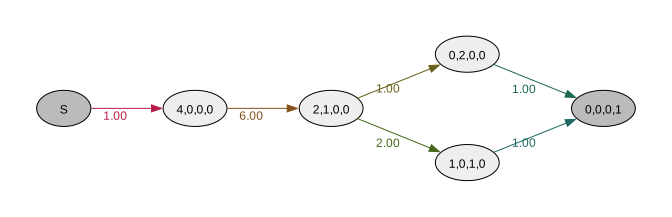
Easy graph build with callback function
You can skip the boilerplate code by passing a callback function and initial state probabilities to Graph. The callback function must accept a list/array of integers specifying a state and it must return a list of lists, each list with two elements: a state (list of integers) and a rate (float). It will often look something like this:
def mygraph(state):
    transitions = []
    for i in state:
        child_state = ...
        rate = ...
        transitions.append([child_state, rate])
    return transitions
To create a callback function, just think of rules of your model and ask yourself: “Given some state, what are the allowed transitions to other states and with what rates to these transitions occur?”. If the current state is “two singletons and one doubleton” ([2, 1, 0, 0]), the process can jump to “one singleton and one tripleton” ([1, 0, 1, 0]) with rate 2 and to “two doubletons” ([0, 2, 0, 0]) with rate 1. Here is a callback function building a graph for the coalescent in the say way as in our first example:
def coalescent(state):
    transitions = []
    for i in range(state.size):
        for j in range(i, state.size):
            same = int(i == j)
            if same and state[i] < 2:
                continue
            if not same and (state[i] < 1 or state[j] < 1):
                continue
            new = state.copy()
            new[i] -= 1
            new[j] -= 1
            new[i+j+1] += 1
            transitions.append((new, state[i]*(state[j]-same)/(1+same)))
return transitionsAlong with the callback function, you must pass the ipv, a list of lists, each with a state and its initial probability. All additional keyword arguments are passed to Graph are passed on to your callback function.
nr_samples = 4
ipv = [([nr_samples]+[0]*(nr_samples-1), 1)]
graph = Graph(coalescent, ipv=ipv)
If the ipv only has a single state Graph also accepts just the single state without the rate of 1:
nr_samples = 4
ipv = [nr_samples]+[0]*(nr_samples-1)
graph = Graph(coalescent, ipv=ipv)
graph.plot()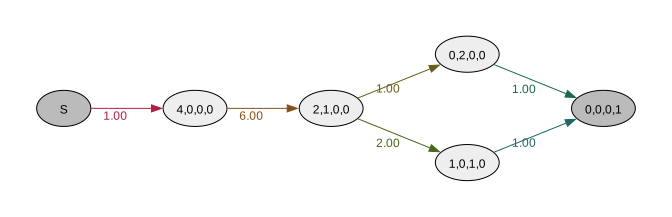
Your callback is wrapped in decorator that makes your function return the ipv if an empty state vector is passed, does various type checks, and formats your return value. To expose this for testing, debugging, or convenience, you can decorate your callback yourself (in which case phasic will know and not do it again):
from phasic import with_ipv

@with_ipv([nr_samples]+[0]*(nr_samples-1))
def coalescent(state):
    transitions = []
    for i in range(state.size):
        for j in range(i, state.size):
            same = int(i == j)
            if same and state[i] < 2:
                continue
            if not same and (state[i] < 1 or state[j] < 1):
                continue
            new = state.copy()
            new[i] -= 1
            new[j] -= 1
            new[i+j+1] += 1
            transitions.append((new, state[i]*(state[j]-same)/(1+same)))
    return transitions

graph = Graph(coalescent)
graph.plot()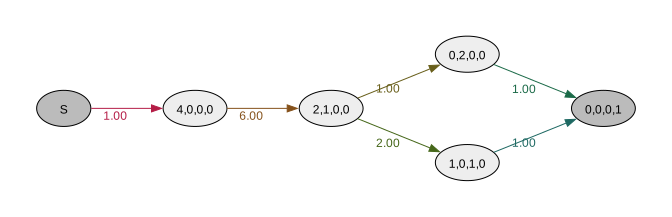
Matrix interface
To allow imbedding in a matrix based workflow, a matrix-based representation of the phase-type distribution can be extracted from the graph. Note that the indices in the matrix representation do not correspond to vertex indices in the graph.
mats = graph.as_matrices()
print("Initial probability vector:")
print(mats.ipv)
print("Subintensity matrix:")
print(mats.sim)
print("States:")
print(mats.states)
print("Indicies:")
print(mats.indices)
Initial probability vector:
[1. 0. 0. 0.]
Subintensity matrix:
[[-6. 6. 0. 0.]
[ 0. -3. 1. 2.]
[ 0. 0. -1. 0.]
[ 0. 0. 0. -1.]]
States:
[[4 0 0 0]
[2 1 0 0]
[0 2 0 0]
[1 0 1 0]]
Indicies:
[2 3 4 5]Although computationally inefficient, the graph can also be constructed from an initial probability vector and a subintensity matrix:
graph = Graph.from_matrices(mats.ipv, mats.sim, mats.states)
graph.plot()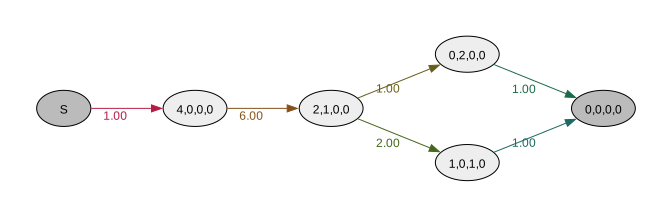
If the state argument is not provided, matrix indices are used as matrix states:
graph = Graph.from_matrices(mats.ipv, mats.sim)
graph.plot()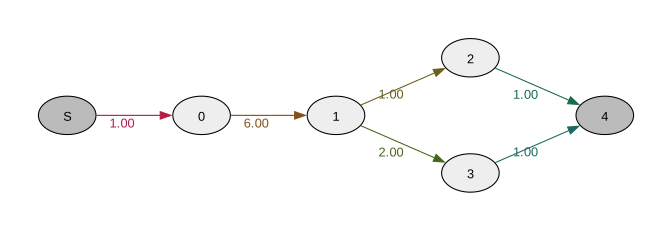
Graph caching
When building graphs using callback functions, the graph cache (~/.phasic_cache/graphs/) allows fast reconstruction of graphs that take a long time to build. This especially true for models (like the coalescent) where each visited vertex requires nested for loops over the state vector.
The cache key is a SHA-256 hash of callback function’s AST (so whitespace/comment changes are ignored) and all other parameters passed to it including the IPV. So any change to the callback code or parameters will invalidate the cache.
from phasic import (
    Graph, with_ipv, GraphCache,
    print_graph_cache_info, get_graph_cache_stats
)
import numpy as np
import seaborn as sns
%config InlineBackend.figure_format = 'svg'
from vscodenb import set_vscode_theme
set_vscode_theme()
sns.set_palette('tab10')
def coalescent(state, N=None):
transitions = []
for i in range(state.size):
for j in range(i, state.size):
same = int(i == j)
if same and state[i] < 2:
continue
if not same and (state[i] < 1 or state[j] < 1):
continue
new = state.copy()
new[i] -= 1
new[j] -= 1
new[i+j+1] += 1
transitions.append((new, state[i]*(state[j]-same)/(1+same) / N ))
return transitions
nr_samples = 40
initial = [([nr_samples]+[0]*(nr_samples-1), 1)]With \(|V|\) vertices and a state vector length of \(s\), building this graph is \(O(|V| s^2)\).
%%time
graph = Graph(coalescent, ipv=initial, N=10000, graph_cache=True)
CPU times: user 9.93 s, sys: 537 ms, total: 10.5 s
Wall time: 10.6 sReconstructing it from cache is only \(O(|V|)\).
%%time
graph = Graph(coalescent, ipv=initial, N=10000, graph_cache=True)
CPU times: user 1.87 s, sys: 98.1 ms, total: 1.97 s
Wall time: 2.04 sIf graph_cache=True is not passed, the graph is built from scratch:
%%time
graph = Graph(coalescent, ipv=initial, N=10000)
CPU times: user 1.82 s, sys: 79 ms, total: 1.9 s
Wall time: 1.95 sCache Inspection
print_graph_cache_info()Cache directory: /Users/kmt/.phasic_cache/graphs
Cached graphs: 1
Total size: 50.93 MBget_graph_cache_stats(){'num_graphs': 1,
'total_size_mb': 50.92820167541504,
'cache_dir': '/Users/kmt/.phasic_cache/graphs'}Custom Class Serialization
StateIndexer supports serialization, but if you want to pass own objects as parameters to the constructor callback, make sure it implements to_dict() and from_dict() and that its __repr__ is deterministic like in the example below:
class MyModel:
    def __init__(self, param1, param2):
        self.param1 = param1
        self.param2 = param2

    def to_dict(self):
        return {'param1': self.param1, 'param2': self.param2}

    @classmethod
    def from_dict(cls, data):
        return cls(data['param1'], data['param2'])

    def __repr__(self):
        return repr({'param1': self.param1, 'param2': self.param2})


@with_ipv(ipv=[1])
def callback(state, model):
    transitions = []
    if state[0] == 1:
        transitions.append([[2], [model.param1, model.param2]])
    return transitions

# Now cacheable!
model = MyModel(1.0, 2.0)
graph = Graph(callback, model=model, graph_cache=True)
Building the state space in C
Some models very large models can be take a long time to construct. To speed this up you implement the model construction using the C or C++ API and import it as a python module. This requires the cppimport available as conda and pypi package.
Here is a function building the coalescent using the C++ API:
phasic::Graph build(int nr_samples) {
  phasic::Graph graph(nr_samples);
  std::vector<int> initial_state(graph.state_length(), 0);
  initial_state[0] = nr_samples;
  phasic::Vertex start = graph.starting_vertex();
  phasic::Vertex initial = graph.find_or_create_vertex(initial_state);
  start.add_edge(initial, 1.0);
  for (size_t k = 1; k < graph.vertices_length(); k++) {
    phasic::Vertex vertex = graph.vertex_at(k);
    for (int i = 0; i < nr_samples; ++i) {
      for (int j = i; j < nr_samples && i + j + 1 < nr_samples; ++j) {
        bool same = (i == j);
        std::vector<int> state = vertex.state();
        if (same && state[i] < 2) {
          continue;
        }
        if (!same && (state[i] < 1 || state[j] < 1)) {
          continue;
        }
        state[i]--;
        state[j]--;
        state[i + j + 1]++;
        double weight = same ? (state[i] + 1) * (state[i] + 2) / 2.0
                              : (state[i] + 1) * (state[j] + 1);
        phasic::Vertex child = graph.find_or_create_vertex(state);
        vertex.add_edge(child, weight);
      }
    }
  }
  return graph;
}
Wrap it in the header and footer shown below and save it to a cpp file named after as your module:
// cppimport
#include <pybind11/pybind11.h>
#include <phasiccpp.h>

#include <vector>

namespace py = pybind11;

using namespace pybind11::literals;

/* ----------------- Don't change the code above! ----------------- */
/* -----------------------------------------------------------------*/

phasic::Graph build(int nr_samples) {
  phasic::Graph graph(nr_samples);
  std::vector<int> initial_state(graph.state_length(), 0);
  initial_state[0] = nr_samples;
  phasic::Vertex start = graph.starting_vertex();
  phasic::Vertex initial = graph.find_or_create_vertex(initial_state);
  start.add_edge(initial, 1.0);
  for (size_t k = 1; k < graph.vertices_length(); k++) {
    phasic::Vertex vertex = graph.vertex_at(k);
    for (int i = 0; i < nr_samples; ++i) {
      for (int j = i; j < nr_samples && i + j + 1 < nr_samples; ++j) {
        bool same = (i == j);
        std::vector<int> state = vertex.state();
        if (same && state[i] < 2) {
          continue;
        }
        if (!same && (state[i] < 1 || state[j] < 1)) {
          continue;
        }
        state[i]--;
        state[j]--;
        state[i + j + 1]++;
        double weight = same ? (state[i] + 1) * (state[i] + 2) / 2.0
                              : (state[i] + 1) * (state[j] + 1);
        phasic::Vertex child = graph.find_or_create_vertex(state);
        vertex.add_edge(child, weight);
      }
    }
  }
  return graph;
}


PYBIND11_MODULE(coalescent_state_space, m) { /* NB: module name must match file base name */

        m.def("build", &build); /* NB: must match name of function defined above */
}
/* -----------------------------------------------------------------*/
/* --------------- Don't change the content below! ---------------- */


/*
<%
import os, sys, phasic
phasic_dir = os.path.dirname(phasic.__file__)
cfg["include_dirs"] += [
    os.path.join(phasic_dir, "include", "c"),
    os.path.join(phasic_dir, "include", "cpp"),
]
# Compile the C++ wrapper implementation alongside this module. The C++
# methods (Graph::starting_vertex, Graph::find_or_create_vertex, etc.)
# are defined out-of-line in phasiccpp.cpp; the phasic_pybind extension
# does not re-export C++ symbols, so we build our own copy here. The
# methods themselves just call into the ptd_* C API, which IS exported
# from phasic_pybind.so.
cfg["sources"] += [os.path.join(phasic_dir, "include", "cpp", "phasiccpp.cpp")]

# Resolve ptd_* symbols at runtime from whatever's already loaded in the
# Python process. The phasic Python package loads phasic_pybind.so into
# the interpreter, which exports the ptd_* C symbols. Dynamic-lookup
# defers resolution to module-load time. IMPORTANT: this only works if
# phasic_pybind's symbols are in the GLOBAL scope, but CPython loads
# extensions with RTLD_LOCAL. So before importing this module you must
# first re-open phasic_pybind with RTLD_GLOBAL (see the import cell
# below). On macOS we also pass -undefined,dynamic_lookup; on Windows
# we'd need to link against an import library.
if sys.platform == "darwin":
    cfg["extra_link_args"] += ["-Wl,-undefined,dynamic_lookup"]
elif sys.platform == "win32":
    raise RuntimeError(
        "Windows cppimport linkage is not supported in this tutorial. "
        "Build phasic from source or use the Python API directly."
    )
setup_pybind11(cfg)
%>
*/
You can see the complete code in cpp_state_spaces.cpp.
The compiled module resolves phasic’s ptd_* C symbols (and the thread-local ptd_err) from the already-loaded phasic_pybind extension. CPython imports extensions with RTLD_LOCAL, so on Linux those symbols are not in the global dynamic-linker scope by default and the import would fail with undefined symbol: ptd_err. The cell below shows the preamble you need to include to first re-open phasic_pybind with RTLD_GLOBAL to promote its symbols. Then you can import your state space module like any other module. Note also that you need to wrap the C++ graph in a Python Graph object:
## Preamble ############################################################################
import os, glob, ctypes, phasic
if hasattr(os, "RTLD_GLOBAL"):
    _pb = glob.glob(os.path.join(os.path.dirname(phasic.__file__), "phasic_pybind*.so"))
    if _pb:
        ctypes.CDLL(_pb[0], mode=os.RTLD_NOW | os.RTLD_GLOBAL)
import cppimport.import_hook
########################################################################################

import cpp_state_spaces # import your extension

graph = Graph(cpp_state_spaces.coalescent(4)) # wrap the returned pybind11 object in Graph
graph.plot()
graph.expectation()1.4999999999999996Callback-based construction in C++
The C++ API mirrors the Python callback interface directly with Graph::from_callback, so you get the same convenience as Graph(callback, ipv=...) without writing the breadth-first exploration loop by hand. The transition callback returns a std::vector<phasic::Transition> — each Transition is a target state, a weight, and optional coefficients (non-empty for parameterised edges) — and Graph::from_callback explores the state space for you:
phasic::Graph coalescent(int nr_samples) {
  std::vector<int> initial_state(nr_samples, 0);
  initial_state[0] = nr_samples;                                   // [nr_samples, 0, 0, ...]
  std::vector<std::pair<std::vector<int>, double>> ipv = {{initial_state, 1.0}};

  auto callback =
      [](const std::vector<int> &state) -> std::vector<phasic::Transition> {
    std::vector<phasic::Transition> transitions;
    int size = (int) state.size();
    for (int i = 0; i < size; ++i)
      for (int j = i; j < size; ++j) {
        int same = (i == j) ? 1 : 0;
        if (same && state[i] < 2) continue;
        if (!same && (state[i] < 1 || state[j] < 1)) continue;
        std::vector<int> next = state;                             // state.copy()
        next[i] -= 1; next[j] -= 1; next[i + j + 1] += 1;
        double rate = (double) state[i] * (state[j] - same) / (1 + same);
        transitions.emplace_back(next, rate);                      // constant edge
      }
    return transitions;
  };

  return phasic::Graph::from_callback(nr_samples, ipv, callback);
}
The complete module (with the same // cppimport header/footer as above) is in cpp_callback_construction.cpp. For a standalone program compiled directly with clang++ (no Python), see ../examples/cpp/coalescent_from_callback.cpp.
## Preamble ############################################################################
import os, glob, ctypes, phasic
if hasattr(os, "RTLD_GLOBAL"):
    _pb = glob.glob(os.path.join(os.path.dirname(phasic.__file__), "phasic_pybind*.so"))
    if _pb:
        ctypes.CDLL(_pb[0], mode=os.RTLD_NOW | os.RTLD_GLOBAL)
import cppimport.import_hook
########################################################################################

import cppimport.import_hook
import cpp_callback_construction # import your extension

graph = Graph(cpp_callback_construction.coalescent(4)) # wrap the returned pybind11 object in Graph
graph.expectation()1.5Speed comparison
The CPP version usually builds at about ten times faster:
nr_samples = 40
initial = [([nr_samples]+[0]*(nr_samples-1), 1)]

def coalescent(state):
    transitions = []
    for i in range(state.size):
        for j in range(i, state.size):
            same = int(i == j)
            if same and state[i] < 2:
                continue
            if not same and (state[i] < 1 or state[j] < 1):
                continue
            new = state.copy()
            new[i] -= 1
            new[j] -= 1
            new[i+j+1] += 1
            transitions.append((new, state[i]*(state[j]-same)/(1+same)))
return transitions%%timeit
graph = Graph(coalescent, ipv=initial)1.55 s ± 29.4 ms per loop (mean ± std. dev. of 7 runs, 1 loop each)%%timeit
graph = Graph(cpp_state_spaces.coalescent(nr_samples))568 ms ± 25.5 ms per loop (mean ± std. dev. of 7 runs, 1 loop each)%%timeit
graph = Graph(cpp_callback_construction.coalescent(nr_samples))255 ms ± 3.43 ms per loop (mean ± std. dev. of 7 runs, 1 loop each)