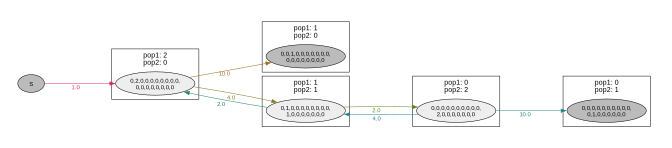
Lets try to estimate both coalescent and migration rate in a two population model.
from phasic import (import sysimport numpy as npimport jax.numpy as jnpimport matplotlib.pyplot as pltimport seaborn as sns4 )import vscodenbimport svgd_tests'tab10' )'INFO' )
[INFO] phasic.graph_cache: Cleared 0 cached graphs
Removed 6 file(s), preserved directory structure
= 2 = StateIndexer(= ['pop1' , min_value= 0 , max_value= nr_samples),'pop2' , min_value= 0 , max_value= nr_samples),'in_pop' , min_value= 1 , max_value= 2 ),= [0 ] * indexer.state_length# set initial state with all lineages having one descendant at both loci = 1 , pop2= 0 , in_pop= 1 )] = nr_samples@with_ipv (initial)def two_island(state):= []if state[indexer.descendants.indices()].sum () <= 1 :return transitionsfor i in range (indexer.descendants.state_length):if state[i] == 0 : continue = indexer.descendants.index_to_props(i)for j in range (i, indexer.descendants.state_length):if state[j] == 0 : continue = indexer.descendants.index_to_props(j)if props_j.in_pop != props_i.in_pop:continue = int (i == j)if same and state[i] < 2 :continue if not same and (state[i] < 1 or state[j] < 1 ):continue = state.copy()-= 1 -= 1 = props_i.pop1 + props_j.pop1= props_i.pop2 + props_j.pop2if des_pop1 <= nr_samples and des_pop2 <= nr_samples:= indexer.descendants.props_to_index(= des_pop1, = des_pop2, = props_i.in_pop+= 1 * (state[j]- same)/ (1 + same), 0 ]])if state[i] > 0 := state.copy()= 2 if props_i.in_pop == 1 else 1 = state.copy()-= 1 = indexer.descendants.props_to_index(= props_i.pop1, = props_i.pop2, = other_pop+= 1 0 , state[i]]])return transitions= Graph(two_island) = [10 , 2 ]def label(state):= sum ([state[i] * bool (indexer.index_to_props(i).descendants.in_pop == 1 ) for i in indexer])= sum ([state[i] * bool (indexer.index_to_props(i).descendants.in_pop == 2 ) for i in indexer])return f"pop1: { nr_pop1} \n pop2: { nr_pop2} " = 'LR' , nodesep= 0.3 , ranksep= 2 ,= 10 , = label)
[INFO] phasic.graph_cache: Saved graph to cache: 7a761bac1791755c... (6 vertices)
[INFO] phasic: Saved graph to cache: 6 vertices
= graph.sample(10000 )
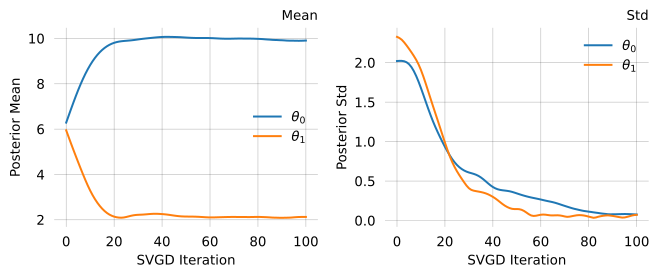
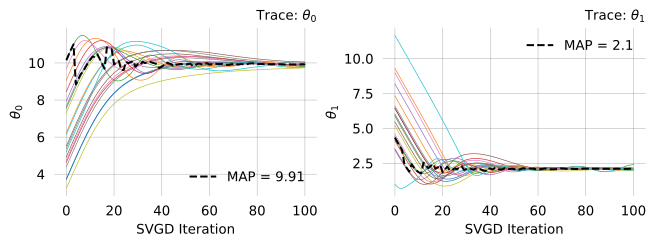
with set_log_level('WARNING' ):= graph.svgd(observations, = [= [2 , 10 ]), = [2 , 10 ]), = 100 , = 20 , = Adam(learning_rate= 0.3 ),
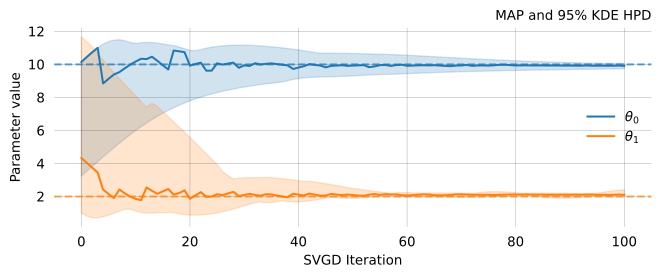
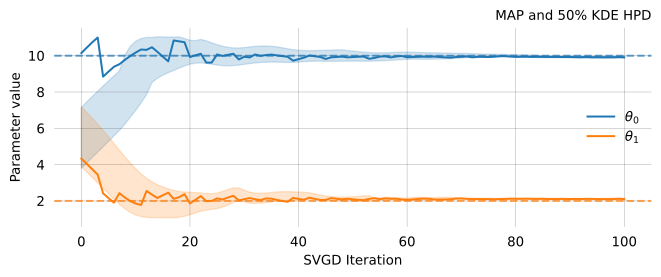
Parameter  Fixed          MAP        Mean       SD         HPD 95% lo   HPD 95% hi
0          No             9.911      9.909      0.07683    9.781        10.06
1          No             2.098      2.126      0.07213    2.004        2.164

Particles: 20, Iterations: 100
= true_theta)
= true_theta, ci= 0.5 )
/var/folders/s6/srs8qkh52w1_h32d65z95tth0000gn/T/ipykernel_88052/3416795907.py:1: DeprecationWarning: plot_ci(ci=...) is deprecated; use ci_level=... instead. It will be removed no earlier than phasic 0.34.0.
  svgd.plot_ci(true_theta=true_theta, ci=0.5)
([9.911009811176747, 2.09810817661949], 7220.119223613634)
= 0.5 )
Parameter  Fixed          MAP        Mean       SD         HPD 50% lo   HPD 50% hi
0          No             9.911      9.909      0.07683    9.902        9.936
1          No             2.098      2.126      0.07213    2.11         2.134

Particles: 20, Iterations: 100
Parameter  Fixed          MAP        Mean       SD         HPD 95% lo   HPD 95% hi
0          No             9.911      9.909      0.07683    9.781        10.06
1          No             2.098      2.126      0.07213    2.004        2.164

Particles: 20, Iterations: 100
with set_log_level('WARNING' ):= True )
= true_theta)
#svgd.animate_pairwise(true_theta=true_theta)
# mutation_rate = 1.2e-4
# joint_prob_graph = graph.joint_prob_graph(indexer,
#                                           reward_only=['pop1', 'pop2'],
#                                           reward_limit=1,
#                                           tot_reward_limit=1,
#                                           mutation_rate=mutation_rate)

# joint_prob_graph.plot(rankdir='LR', nodesep=0.3, ranksep=2,
#                       wrap=10, label_fmt=lambda vertex: str(vertex.index()), by_state=label)
# joint_prob_table = joint_prob_graph.joint_prob_table()
# joint_prob_table
# nr_samples = 2

# indexer = StateIndexer(
#     descendants=[
#     Property('pop1', min_value=0, max_value=nr_samples),
#     Property('pop2', min_value=0, max_value=nr_samples),
#     Property('in_pop', min_value=1, max_value=2),
# ])

# initial = [0] * indexer.state_length

# # set initial state with all lineages having one descendant at both loci
# initial[indexer.descendants.props_to_index(pop1=1, pop2=0, in_pop=1)] = nr_samples

# @with_ipv(initial)
# def two_island(state):
#     transitions = []

#     if state[indexer.descendants.indices()].sum() <= 1:
#         return transitions

#     for i in range(indexer.descendants.state_length):
#         if state[i] == 0: continue
#         props_i = indexer.descendants.index_to_props(i)

#         for j in range(i, indexer.descendants.state_length):
#             if state[j] == 0: continue
#             props_j = indexer.descendants.index_to_props(j)

#             if props_j.in_pop != props_i.in_pop:
#                 continue

#             same = int(i == j)
#             if same and state[i] < 2:
#                 continue
#             if not same and (state[i] < 1 or state[j] < 1):
#                 continue

#             child = state.copy()
#             child[i] -= 1
#             child[j] -= 1
#             des_pop1 = props_i.pop1 + props_j.pop1
#             des_pop2 = props_i.pop2 + props_j.pop2
#             if des_pop1 <= nr_samples and des_pop2 <= nr_samples:
#                 k = indexer.descendants.props_to_index(
#                     pop1=des_pop1,
#                     pop2=des_pop2,
#                     in_pop=props_i.in_pop
#                     )
#                 child[k] += 1
#                 transitions.append([child, [state[i]*(state[j]-same)/(1+same), 0]])

#         if state[i] > 0:
#             child = state.copy()
#             other_pop = 2 if props_i.in_pop == 1 else 1
#             child = state.copy()
#             child[i] -= 1
#             k = indexer.descendants.props_to_index(
#                 pop1=props_i.pop1,
#                 pop2=props_i.pop2,
#                 in_pop=other_pop
#                 )
#             child[k] += 1

#             transitions.append([child, [0, state[i]]])

#     return transitions

# graph = Graph(two_island)

# true_theta = [0.7, 0.3]
# graph.update_weights(true_theta)
# graph.plot(rankdir='LR', by_index=lambda i: f"Desc in pop1: {indexer.index_to_props(i).descendants.pop1}")
# graph.plot(rankdir='LR', by_state=lambda s: f"In pop1: {s[indexer.descendants.props_to_index(pop1=1)].sum()}")